Skip to content

Research

Reports

1582 reports

Kinetiq: Building the Hyperliquid Economy

Hyperliquid has built a successful exchange, but its broader onchain economy remains underdeveloped. Kinetiq’s Elysium aims to address infrastructure constraints that make some financial applications difficult or uneconomical to operate. Its proposed capabilities and announced ecosystem support give the supply-side case credibility, while sustained demand remains unproven. If Elysium and Kinetiq’s social trading app, Markets, succeed, Kinetiq could become a core provider of infrastructure and distribution across Hyperliquid.

The AI Boom Has a Power Problem

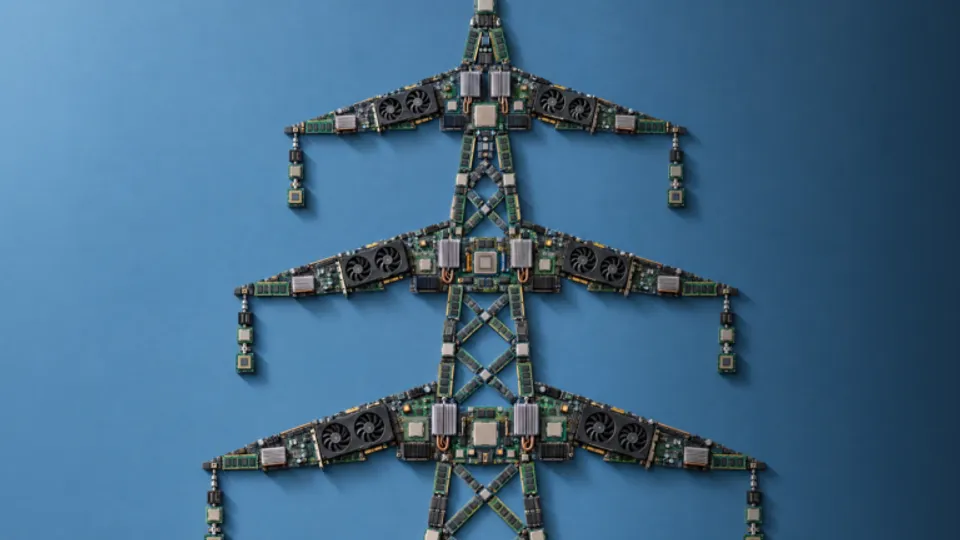
AI’s main constraint is shifting from chips to power: chip supply scales in quarters, but generation and transmission take years, and grid access can’t be bought with a higher price. The report evaluates every major source of new power on speed, cost and firmness, from gas turbines, fuel cells and on-site engines to nuclear restarts and uprates, SMRs, solar, geothermal and fusion. It then follows the scarcity into turbine slots, castings, transformers, skilled crews, nuclear fuel, transmission, and storage.

ETHGas: Institutional Blockspace on Ethereum

Following our initial coverage of ETHGas, this report explores how its Institutional Blockspace architecture addresses key barriers to institutional adoption of Ethereum. By introducing policy-controlled block construction, predictable execution conditions, and qualified validator participation, ETHGas enables institutions to operate within defined compliance and execution requirements while retaining Ethereum's shared settlement infrastructure.

The House Always Wins: Why Speculation is the Theme of the Decade

Speculation has always had two engines. One is technology, which rearranges what is possible. The other is a strained political and monetary order, where the normal path no longer works for the average person. In the 2020s both are running at once. We trace four centuries of manias and map out who collects this time.

The Theory of (Mostly) Everything: Part 2

The Delphi Macro Regime now incorporates leading indicators of global growth and inflation alongside liquidity. Today the model reads neutral and paints a more cautious picture than the liquidity-only model.

The Emerging Onchain Equity Market

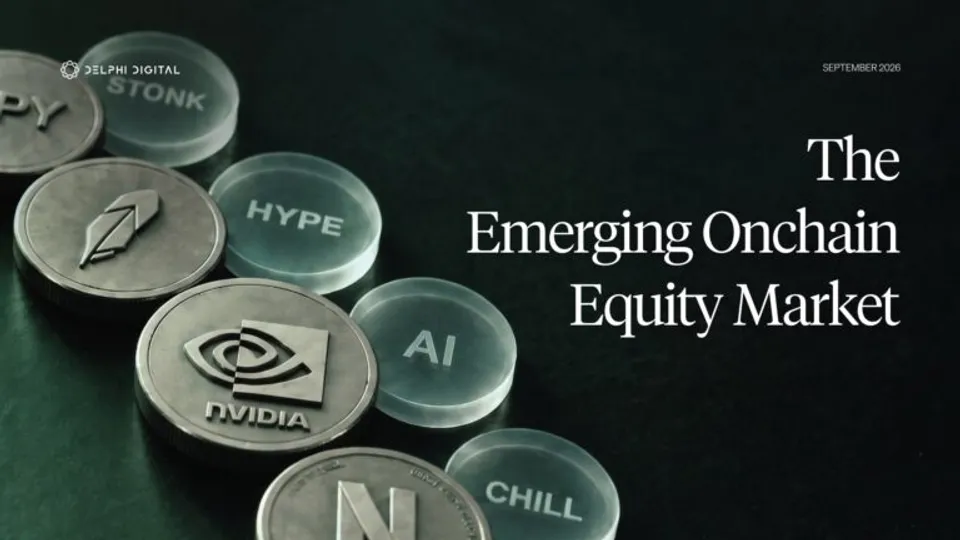
Tokenized stocks are now a roughly $3B market, but only about 6% of that value is deployed in DeFi. This report examines what investors own across the main token structures, how firms like Alpaca and Backpack are connecting onchain markets to the underlying shares, and why lending protocols still need readily available pool liquidity. It compares execution across venues and explores the uses emerging around these holdings, from lending and margin collateral to stock-linked memes and consumer rewards.

Synaptrix: I think, therefore I can

Synaptrix is building the decoding layer for the next generation of human-machine interfaces. Its Portal headset pairs non-invasive neural sensing with large motor-cortex foundation models that translate intended movement directly into device commands. Bypassing the low-bandwidth keyboards, touchscreens and joysticks through which we interact with technology today, neural interfaces open the path to a different interaction paradigm — with much higher bandwidth and dimensionality, enabling device control through thought alone.

MetaDAO: Beyond The Token Sale

MetaDAO is evolving beyond token issuance into a system that connects market-based fundraising with liquidity, treasury governance and post-launch accountability. This report assesses how far that model has progressed across its curated launches and where the evidence remains early. It examines whether MetaDAO can improve project selection, create more durable ownership, protect capital when execution fails and build a repeatable economic model around successful issuers.

PoUW: Can Computation Become Consensus?

Proof-of-work has historically been the standard consensus mechanism in blockchains, turning computation into economic security. At the same time, a separate compute economy has emerged around AI. The concept of Proof-of-Useful-Work (PoUW) was born from the question on whether PoW consensus could be implemented on top of real-world computation, and aims to combine these two compute economies. In this report we explore the technical, economic, and usefulness viability of today’s PoUW architecture.

Evaluating the AI Labs of China

Chinese models are near-parity on benchmarks, dramatically cheaper per intelligence task, and topped US models in OpenRouter token share for the first time in 2026, all through legitimate contributions across quantization, attention architectures, MoE sparsity, and RL. This report walks through what that inversion does and doesn't mean, then breaks the labs' progress into three efficiency themes across systems, architecture, and post-training, mapping the listed names positioned to benefit from each.

The State Of Tokenized Stocks

Centralized exchanges (CEXs) came to tokenized stocks well after the onchain issuers had introduced the category, but they arrived with wider catalogs and order books of their own. Binance is the newest entrant and it scaled fastest in July, though most of that volume came from QQQB, a single token tracking the Nasdaq 100 ETF. What it costs you to trade tokenized stocks (for the time being) depends entirely on where you buy and when.

Avalanche Is the Business Chain for Real-World Finance

The story on Avalanche has moved past issuance. Tokenized RWA value has grown from $740M to over $3B since October, with Progmat's Japan migration complete, Galaxy proving out tokenized CLOs and onchain proxy voting, and Aave choosing the network for V4's first deployment beyond Ethereum. The report covers what gets built on top of those assets, from the credit operations stack coming onchain to the stablecoin payment rails aiming to reach half of South Korea's card volume. It closes with the yield layer distributing all of it across the globe and the flywheel forming between the three.

Task Markets

Agentic commerce is converging on a new primitive, the task: a verified unit of completed work. Three forces are driving the shift. Agents are capable but break on multi-leg work; therefore work must decompose into verifiable chunks. Coordination is the bottleneck, not capacity. Across the economy, more time is spent waiting on process than executing. And the subsidy era is ending: usage-based billing is repricing agent labor from cost-per-token to cost-per-task.

The Case For Plasma One: Stablecoins Are Eating The World

Stablecoin supply has grown from roughly $5B in 2019 to more than $320B, with linked card spend reaching an $18B annualized run rate by August 2025. Users still manage balances across exchanges, P2P brokers, wallets, and card programs, while most card transactions convert back to fiat before settlement. Plasma One combines a stablecoin-native account and card with its own L1, supporting gasless USDT transfers and closer coordination of account flows and reconciliation. Since January 2026, it has recorded $32M across roughly 221,000 card transactions.

The Crowded Book

Three names with nothing in common, ZEC, HYPE and VVV, traded as one position through 2026's narrowing market. June 4 stress-tested the trade: all three fell together, then recovered 135%, 85% and 52% of their drops. The Crowded Book asks whether crowding is actually the risk. Our conclusion: it isn't. What matters is whether the bid is funded or borrowed, and the report closes with a scorecard on the three names

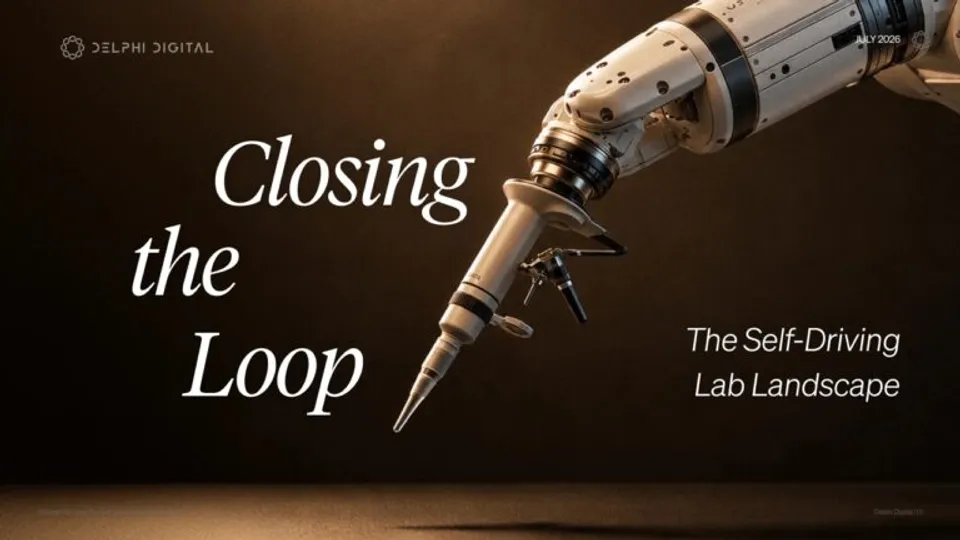
Closing the Loop: The Self-Driving Lab Landscape

Self-driving labs combine AI and robotics to run the full scientific design-make-test-analyze cycle autonomously, compressing an iteration loop that takes months in a conventional lab down to days or hours. The report maps the ecosystem across its full value chain: hardware incumbents consolidating around integrated workcells, an orchestration layer where execution is commoditizing while provenance-linked data becomes the contested asset, and full-stack discovery companies that have absorbed roughly 82% of the more than $3B deployed since 2024.

JTX: Solana’s New Trading Layer

Jito's self-custodial trading app is going after a seat nobody on Solana has filled yet, a single venue that cleanly packages the chain's liquidity and execution for active traders across all assets and instruments. The report covers the full stack behind it, the tokenized stock opportunity with nearly all onchain stock volume already clearing on Solana, and a grounded revenue view showcasing the 80% of JTX fees earmarked for JTO buybacks. Jupiter and the other terminals own today's habits, so the next couple of quarters are about proving execution and retention.

Macro & Markets Mid Year Report Card

Dispersion, the supply overhang, and Hyperliquid were the standout calls in the first half. The macro turn is more defensive heading in 2H26, with a hawkish Fed and rising real yields pointing to a potential vol event.

Arcium: Enabling The Next Phase Of Private On-Chain Activity

Stablecoin payments grew from $1.9B a month in early 2023 to over $10B by mid-2025, yet growth flattens outside contractor payroll, remittances, and card spend. A salary paid on-chain publishes the amount, the employer, and the pay cycle, so companies try the rails once and quietly move payroll back off-chain. Arcium keeps settlement public and moves the computation out of view. The chain verifies the transfer without seeing the balances and counterparties behind it.

Aerodrome Valuation Framework

How should one value AERO? On the cash it actually returns to holders it screens cheap, routing ~100% of its fees and bribes to veAERO and trading at a fraction of Uniswap's revenue multiple. But it still emits more than it earns most months, the top line has fallen off its 2025 highs. However, there are catalysts on the horizon with the move to Ethereum, AER engine, Circle's Arc and more.

A Framework For Crypto Neobanks

Today, there are hundreds of different crypto cards to choose from, many of which offer marginal improvements over the next. But the winners will likely be the companies that use cards as an entry point into something larger: stablecoin-native banking, cross-border remittances, DeFi-linked financial accounts, issuer infrastructure, or region-specific dollar access.

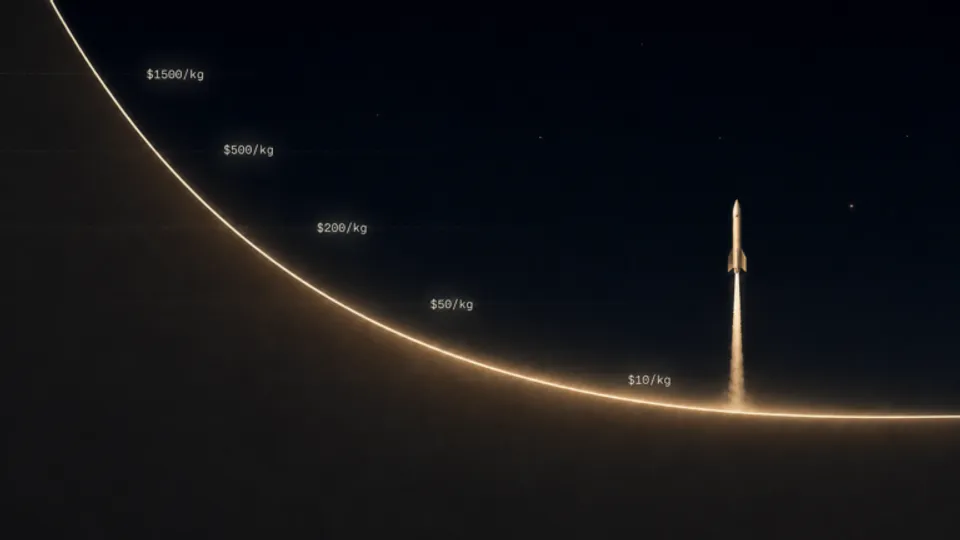
Escape Velocity For The Final Frontier

SpaceX flew 8 orbital missions in 2016 and 165 in 2025, and the cost of reaching orbit, which barely moved for the first sixty years of the space age, is now on course for a further 60x compression by 2045. This report maps that decline across five price thresholds, from $1,500/kg to $10/kg, and the industries each one makes possible for the first time, from orbital compute and commercial stations to microgravity pharma, lunar propellant, and a Mars supply chain.

1–24 of 1582 reports